From Poland to the Ruhr, Then Down the French Mines
Some Polish families reached the French coalfields after a generation in Germany. Their history explains why a French miner’s record can lead first to the Ruhr, and why following the whole household matters as much as finding the man who went underground.
Written by Arnaud Ruiz
When Kasimir Zgorecki arrived in the French coalfields in 1922, his family had already made one migration west. His parents came from the Poznań region; he had been born in Recklinghausen, in Germany’s Ruhr district, in 1904. The family settled in Rouvroy, and father and son worked for the Compagnie des mines de Courrières at Billy-Montigny.1
Kasimir’s mining career was brief. Trained as a boilermaker, he turned to photography and in 1924 took over his brother-in-law’s studio and bookshop. He would photograph the Polish community of the French coalfields through the interwar years. A migrant who had followed his father into mining became one of the people who recorded the lives being built around it.2
For descendants, that German birthplace can be the unexpected part. A family remembered as Polish and rooted for generations in France may have spent years in a third country. The Ruhr was where parents found work, children were born and families established themselves before moving again. Understanding that earlier chapter changes where a genealogist looks next.
Leaving Polish lands before there was a Polish state
When large numbers of Polish-speaking workers began moving to the Ruhr in the nineteenth century, an independent Poland did not exist. The partitions of the late eighteenth century had divided its territory among Prussia, Russia and Austria. The Polish state was re-established in 1918.3
Many of the people later called Ruhr Poles came from Prussia’s eastern provinces, including Posen, now associated with Poznań, East and West Prussia, and Silesia. As Prussian citizens, they were moving within the same state. Following German unification in 1871, their journey remained an internal migration within the German Empire. Their Polish language and origins coexisted with Prussian citizenship.4
The Ruhr Polish population was itself diverse, including Protestant Masurians as well as Catholic migrants from other regions.4
The mines needed workers, and recruitment from the east expanded through personal connections as well as employers’ agents. Letters and news from those already in the Ruhr helped relatives and neighbours follow. Over time, the movement involved hundreds of thousands of people.4
This helps explain the apparent contradiction in a later French record. A German birthplace could belong to a child of Polish-speaking parents who had moved west for work. By the time that child reached France, the family’s migration was already a generation old.
A Polish community takes shape in the Ruhr
In Bochum, the inscription Bank Robotników survives on a wall at Am Kortländer. The Polish Workers’ Bank belonged to a district where Polish institutions, including trade-union offices and banks, gathered around the former Redemptorist monastery. The neighbourhood became known as Klein-Warschau, or Little Warsaw.5
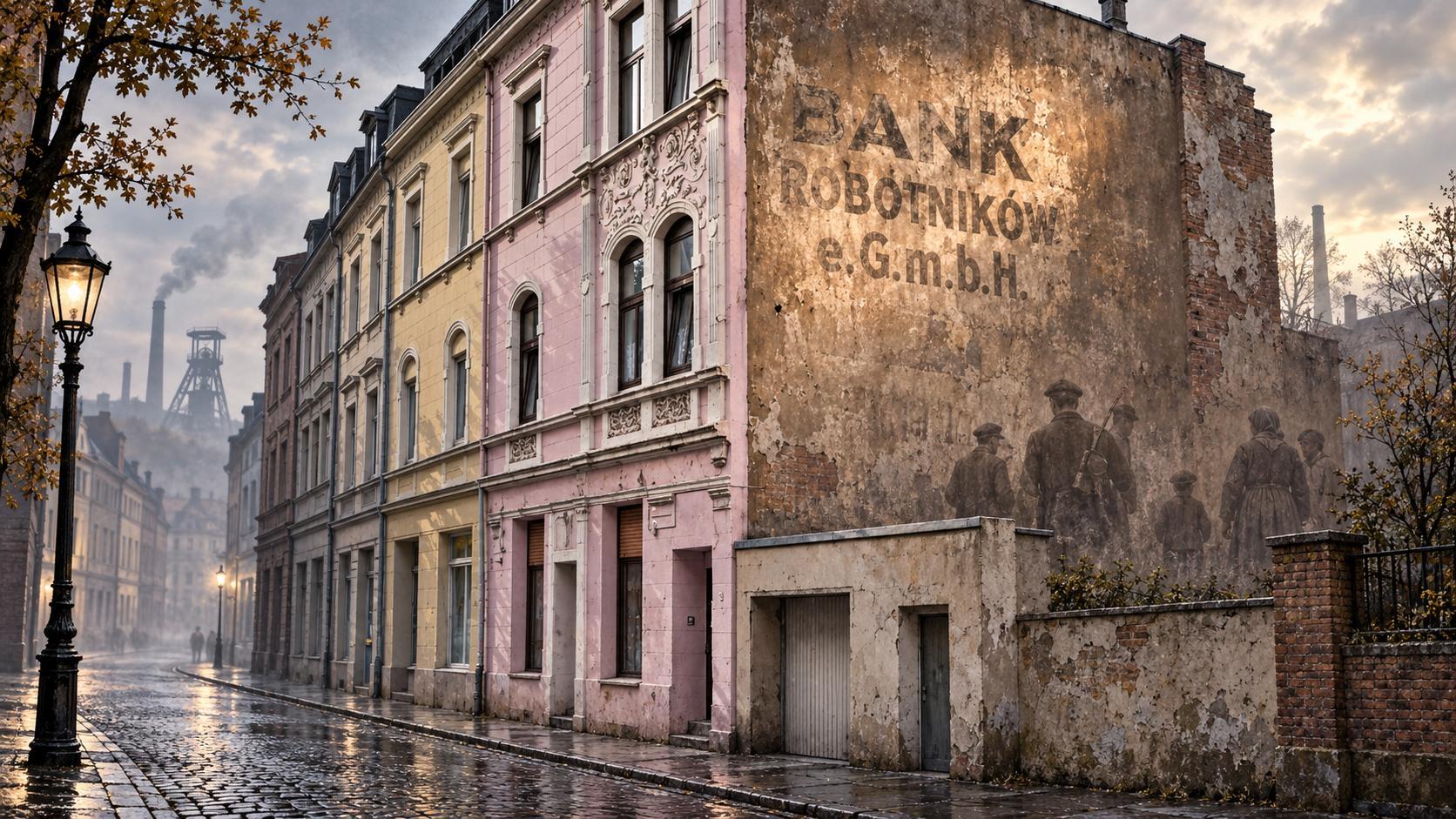
The sign helps explain the scale of settlement. A bank and a trade union served a population with wages to manage, disputes to pursue and reasons to organise its own affairs. The community had acquired institutions that could outlast any one worker’s contract.
Women’s work helped sustain households. In Bochum, Polish women found employment in cleaning and textile work; taking in lodgers also supplemented family income. The changing balance between men and women shows how settlement developed. Figures cited by Porta Polonica record 39.7 women for every 100 male migrants in 1890, rising to 76.8 by 1910 as families followed the earlier arrivals.6
Polish organisations attracted official suspicion. In 1909, a central office for monitoring the Polish movement was established in Bochum. Associations and meetings became subjects of police observation. The same community that supported a family’s daily life could place its members under scrutiny.6
The bank sign survives from this history of self-organisation under pressure. For a family that later left Germany, the Ruhr years could encompass a marriage, the birth of children and a long period of industrial employment. Leaving for France meant moving from a place where a substantial Polish community already existed.
Why France recruited miners from Germany
The First World War redirected this migration. Poland regained independence, while the French coalfields faced destroyed installations and a severe shortage of labour. Restoring coal production was part of rebuilding the country. France sought workers abroad, and employers took an increasingly large role in organising recruitment. The Comité central des houillères de France and the Société générale d’immigration helped turn that demand into a system for bringing labour into the country.7
On 3 September 1919, France and Poland signed an immigration convention providing for organised recruitment, employment contracts and equal wages with French workers. The agreement helped bring a new stream of migrants from Poland. Alongside them came Polish miners who already knew industrial work from the Ruhr.8
In France these experienced arrivals became known as Westphaliens, or Westphalians. They brought knowledge of coal extraction acquired in German pits, while many newcomers from Poland had to learn the trade. The Westphalians were therefore particularly valuable to an industry trying to restore production.9
Recruitment reached into the Ruhr itself. The French coal industry’s central committee opened an office in Duisburg in January 1922. The chronology published for the Jeu de Paume’s Studio Zgorecki exhibition estimates that between 100,000 and 130,000 Polish Westphalian workers moved into French industry between 1920 and 1925.1
Some Ruhr Poles moved to the restored Polish state; others remained in Germany or went elsewhere in western Europe.4 France was recruiting for work many of them already knew.
Even an experienced miner had adjustments to make. Historian Philip H. Slaby finds that men trained in German mines initially produced less coal than seasoned French workers.10 A familiar occupation still meant entering a different workplace. The transfer of skills did not remove the need to learn how a new pit operated.
By 1931, more than half a million Polish nationals were recorded in France, making them the country’s second-largest foreign nationality after Italians. They lived well beyond the northern coalfields, including in other mining regions and agricultural districts.8 The Zgoreckis belonged to a migration that was changing the geography of Polish life in France.
Settling under the company’s roof
The companies also needed their recruits to stay. They encouraged family settlement, providing accommodation that allowed wives and children to join men already employed in France. The corons, the rows of miners’ houses associated with the northern coalfields, became places where work and family life were closely connected.9
His study of the Pas-de-Calais also shows how deliberately employers supported this settlement. Companies helped finance Polish clubs and religious life, and sometimes concentrated Polish households in particular housing areas. Managers hoped that a familiar social environment would make workers more likely to stay. These arrangements also reinforced separation between Polish migrants and their French neighbours.10
The resulting communities owed much to the migrants’ own efforts. Polish shops opened, associations developed and newspapers followed their readers west. Wiarus Polski moved from the Ruhr to Lille; Narodowiec established itself in Lens. Families could read news in Polish while living and working in France. Polish-language teaching helped transmit the language to children, and the demand for it brought provision for such lessons where enough pupils of the same nationality attended school.3
The company’s influence extended well beyond the shift underground. Slaby describes a system intended to retain the present workforce and help produce the next, with miners’ children growing up close to the industry. Housing and cultural support were practical benefits, embedded in an employer’s calculations about labour.10
Kasimir’s change of occupation belongs in this setting. A community of miners also needed businesses and services. His brother-in-law could teach him photography and pass on a studio that served the people settling around the pits.2 The family connection that helped him find a new trade is a useful reminder of how much a migration story can contain beyond the original job.
The family missing from one employment card
Women also appear in the employment records of the French mines. A law of 1874 prohibited their employment underground; at Lens, many worked at the surface as trieuses, separating coal from unwanted material.11
One case published by the Archives nationales du monde du travail reveals how unevenly a family could be recorded. Wladislawa Wisnicka, a coal sorter employed by the Compagnie des mines de Lens, arrived in France in 1931. Her husband, Jean Kozlowski, had arrived in 1926. His personnel card names six children who are absent from hers. When her employment ended in 1932, her card recorded “plus de travail”, meaning “no more work”.11
The archive’s account does not establish a Ruhr connection for this couple. It does show how a family could arrive in stages and be recorded unevenly. Read together, their cards describe a household that would remain largely invisible in the wife’s employment record alone. Her departure note closes a period of paid work; the family’s subsequent history has to be sought elsewhere.
When the work ran out
Settlement in France offered no guarantee of permanence. The economic crisis of the 1930s brought dismissals and departures. The Musée national de l’histoire de l’immigration distinguishes individual expulsions from organised collective repatriations, through which whole families were sent back to Poland. Recruitment had encouraged families to make a home near the pits. An economic downturn could now put their continued presence in question.8
Even the word “return” carried different meanings within one household. For a parent born in Polish lands, it could describe a journey to a familiar place. A child born in the Ruhr or France might be going to a country where they had never lived. A family’s route across Europe could contain several such beginnings, separated by years of work and settlement.
Following the household back through the records
Begin with the most securely identified person in France. Record the name exactly as written, the birth date and place, the spouse, the address and the employer. Keep the date of the document separate from the date of the event it describes. A late record may be recounting an arrival many years earlier.
The Archives nationales du monde du travail in Roubaix is a key starting point for mining employment records. Its genealogy guide explains what is needed for a useful search: names, birth details, the company and an approximate period of employment. Many older mining personnel records are online, but coverage and indexing are incomplete. An unsuccessful name search does not establish that someone never worked there.12
Once a card is found, read every side and attached page. Separate the mining company from the pit number and the home address. Copy unfamiliar place names before trying to modernise them. Preserve variant spellings until other details show that the records concern the same person. A matching surname is a lead; a matching birth date, spouse and sequence of addresses make a much stronger identification.
Then search the household. Compare spouses’ records and follow the children’s birthplaces through time. Use census entries, civil registrations and records of foreigners to fill the intervals. Record gaps honestly: the end of employment at one mine could be followed by another job, a move within France or a departure abroad.
In the Pas-de-Calais, the departmental archives’ guide to foreigners identifies municipal population and police records as well as departmental holdings. Their survival varies. Ask about the particular commune and period rather than assuming that one town’s collection has an equivalent everywhere. Naturalisation research may require the Archives nationales, since most departmental naturalisation files in the Pas-de-Calais were not retained.9
If the evidence points to the Ruhr, carry the search to the correct German municipality. Bochum’s city archive, for example, provides finding aids for historical birth, marriage and death registers, while duplicate registers are held at the state archive in Detmold.13 Each municipality needs its own search.
Finally, establish the eastern place of origin as precisely as possible. Preserve both the historical form and its verified modern equivalent. Work back through the people already identified, especially parents named in civil records. Skipping from a French surname directly to a similarly named family in Poland risks losing the German generation that would prove or disprove the connection.
Finding the setting as well as the person
Personnel records and the history of a mine answer different questions. The Centre Historique Minier at Lewarde holds company archives that can explain recruitment, housing and the organisation of work. Its archive guide directs enquiries about individual personnel dossiers to the Archives nationales du monde du travail or the Agence nationale pour la garantie des droits des mineurs.14
Use FranceArchives to help locate collections, then check the holding institution, employer and dates. Lens and Aniche were different companies. Their records cannot be treated as interchangeable, however close their operations appear on a modern map.
War-damage records offer another way to understand an address. In the Pas-de-Calais, mining-company claims include plans and information about settlements, schools and other company property.15 A dated address from a family record can be compared with these plans to reconstruct the setting of a household’s life. Read the documents according to their purpose: a compensation claim describes losses, a personnel card serves an employer, and a police report records the authorities’ view.
Kasimir Zgorecki’s photographs offer a different view of the communities created around these workplaces. His subjects appear as people with lives beyond their employment, in images made by someone whose own family had travelled from the Ruhr to the French coalfields.2
For descendants, the most revealing discovery may be the document that connects those two places: a birthplace on a French card, a German marriage entry, or a parent’s name that leads farther east. Follow that connection carefully. The family remembered in France may have begun its journey west a generation before anyone arrived there.