The Paper Trail of Poverty: Navigating the Records of the Society of Benevolence
Explore the records of the Dutch Colonies of Benevolence and discover how registers, letters and disciplinary files can reveal your ancestors’ lives.
Written by Arnaud Ruiz
A visit to a sick sister could require official permission. So could a trip to settle an inheritance. In the nineteenth-century Dutch settlements known as the Colonies of Benevolence, residents of the “free” colonies had to apply for leave before going away on family business.
The Drents Archive ’s research guide gives these reasons among the details preserved in the minutes of the Kleine Raad, the council that handled such requests. A sister suffering from tuberculosis appears in the guide’s examples. An ordinary family obligation had become an administrative matter, leaving a trace for descendants to find almost two centuries later.

That small detail brings the colonies into focus. Founded to help poor people support themselves through agricultural work, they offered housing, schooling, and an organized new life. They also brought people under supervision that could reach into their family relationships.
For genealogists, the resulting paperwork offers an unusually close view of lives that might otherwise be difficult to reconstruct. Reading it requires attention to the institution holding the pen.
A new life on reclaimed land
The experiment began in a country struggling after the Napoleonic wars. The official history describes severe poverty and unemployment, an empty treasury, and an unsettled social order. Johannes van den Bosch, a general with experience in the Dutch East Indies, proposed an ambitious response: give poor people homes and land, then have them earn their maintenance through work.
Between 1818 and 1825, seven agricultural colonies were established across the northern and southern parts of the United Kingdom of the Netherlands, which then included present-day Belgium. The project combined two transformations: bringing uncultivated land into production and making its residents economically self-supporting.
Frederiksoord came first. By the end of 1818, it had 52 small farmhouses ready for poor families arriving from towns and cities.
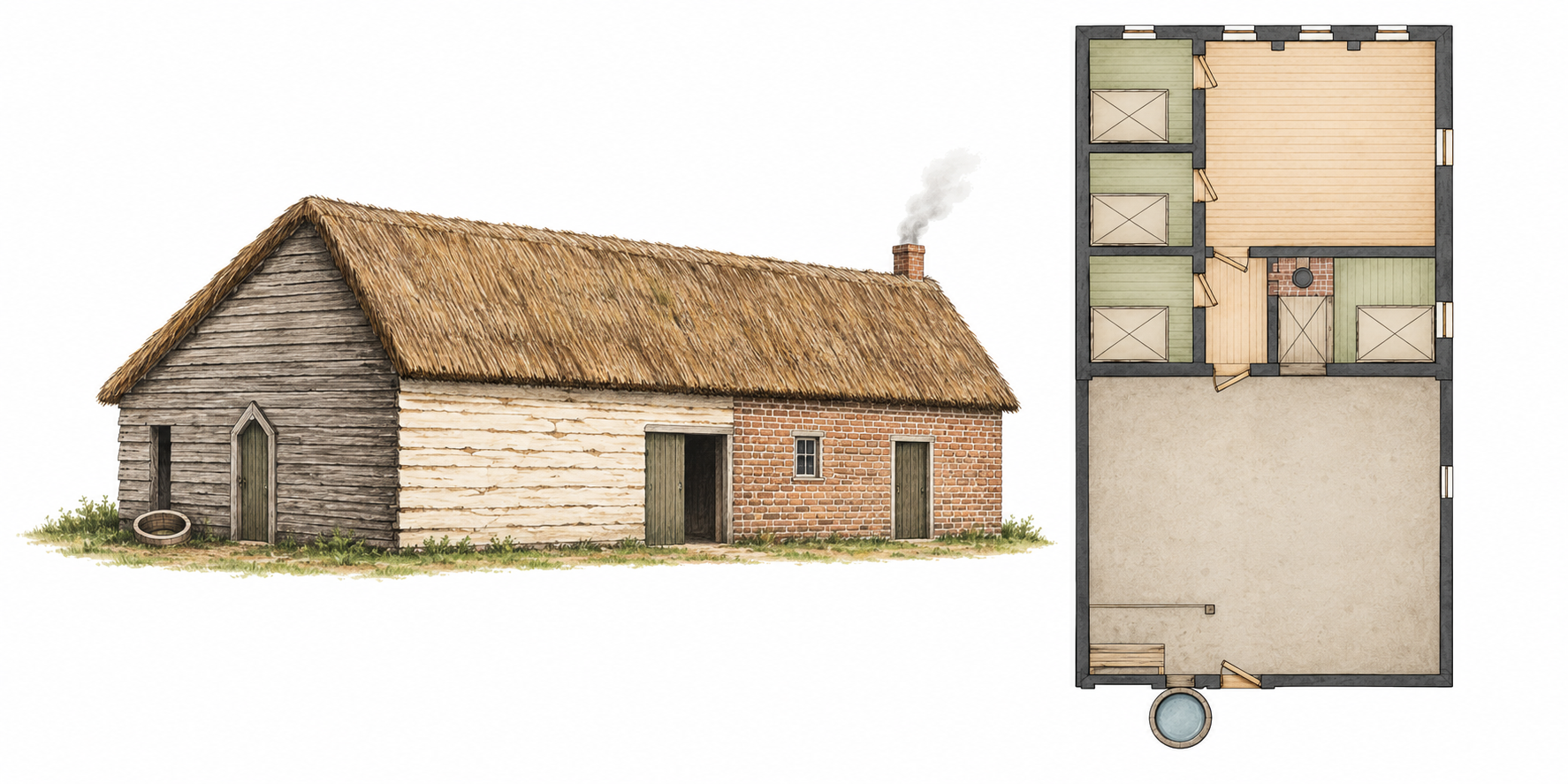
The organization behind it, the Maatschappij van Weldadigheid, or Society of Benevolence, provided work and shelter. Children were required to attend school, and the settlement had its own sickness fund. Churches, shops, schools, and homes for older people became part of the wider undertaking.
These provisions help explain the scheme’s appeal. A family facing insecure work and housing could be offered a home and a means of earning a living. Schooling gave children something their parents might struggle to provide.
The move also demanded a great deal. The project expected people to make their livelihoods within a planned agricultural community. Its success depended on residents’ labor, the productivity of the land, and the institution’s ability to organize both.
The plan was built into the landscape
The colonies’ physical arrangement expressed their purpose. In Frederiksoord and Wilhelminaoord, families occupied small farms along planted avenues. Veenhuizen had large communal residential buildings and centralized farms, accommodating orphans, beggars, and vagrants under guards’ supervision.
UNESCO describes the settlements as panoptic: designed to make observation and supervision possible. Straight roads, ordered fields, housing, churches, and communal facilities formed a landscape organized around work and oversight.
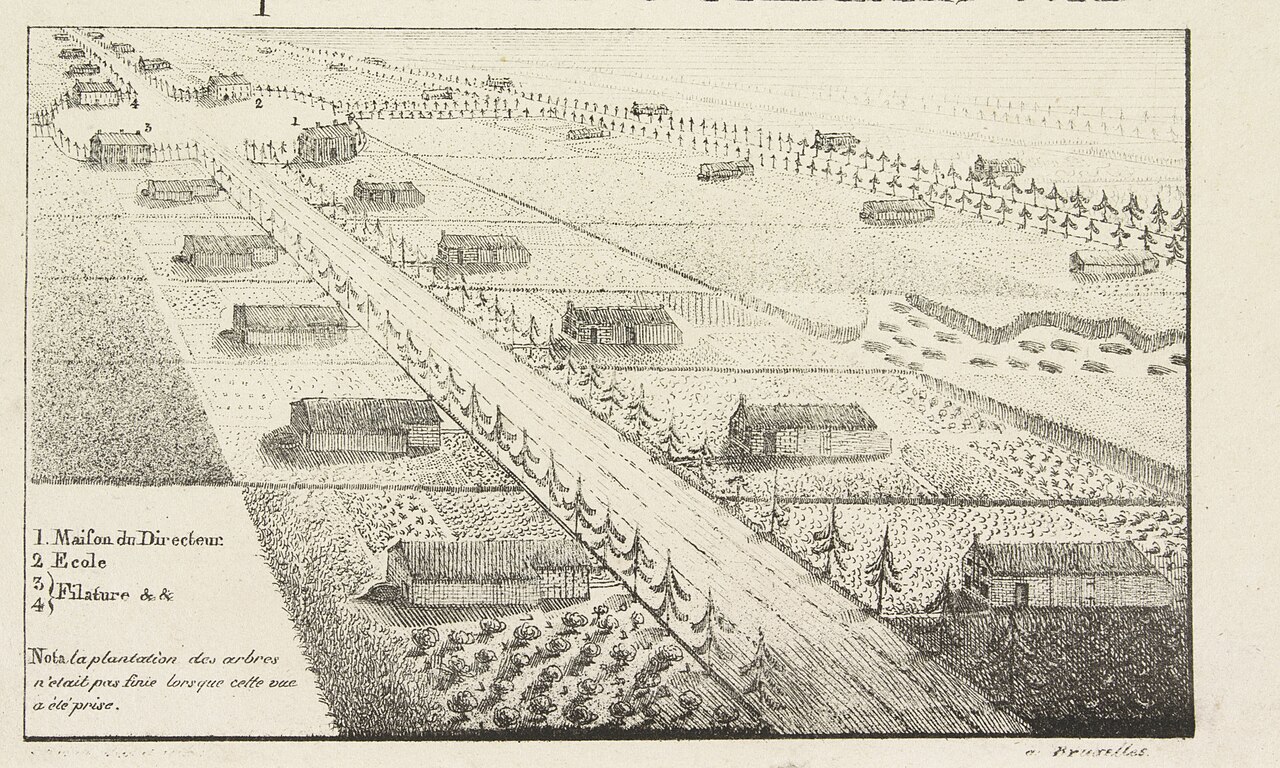
Four colonies now belong to the World Heritage property: Frederiksoord, Wilhelminaoord, and Veenhuizen in the Netherlands, and Wortel in Belgium. Their surviving layouts preserve the different arrangements used for families and institutional populations.
At Veenhuizen, the message could be written directly on a building. The National Prison Museum points to inscriptions including Orde en Tucht, meaning order and discipline, and Werk en Bid, work and pray. Such words convey the expectations surrounding life there.
For someone tracing an ancestor, the distinction between a family farmhouse and a communal institution matters immediately. Both might produce a record naming a colony. The living arrangements, administrative category, and circumstances of admission could be very different.
The historical labels “free” and “unfree” distinguish these forms of settlement. The free colonies housed families on small farms; the unfree colony at Veenhuizen organized communal life and labor under guard. The leave applications in the free colonies show how regulation also reached into the family settlements.
A household could contain several histories
Even within the free colonies, a list of people sharing a home needs careful reading.
The archives use the term ingedeelden for people placed in the household of a free colonist family. Early placements often involved orphaned or poor children. Later, people of many ages, including elderly residents, could belong to this category. They were placed through arrangements with an organization or an individual.
Their entries appear alongside the household that accommodated them. A person sharing a farmhouse with your ancestor therefore needs to be identified through the record’s description of the placement. A shared address alone cannot establish a family relationship.
This is where the structure of an archive starts to shape the investigation. The Drents Archief explains that there is no single register covering every resident. Different groups had different records: free colonist families, workers’ families, staff, veterans, people registered as beggars, and children at Veenhuizen.
Residents could change categories during their stay. Following a person may consequently mean moving between series of records, even when the broader setting remains the same.
A name that disappears from one register becomes a question about movement. Look for a transfer, a change in status, or a reference to another volume before treating the disappearance as the end of the story.
Discipline left its own paper trail
The Society maintained a punishment colony at Ommerschans for residents whom its disciplinary councils judged to have misbehaved. People could be sent there from several groups, including free colonists, children, and workers’ families.
Administrative shorthand can reveal these transfers. The archival guide explains that BK refers to the bankolonie, the punishment or banishment colony. WK refers to the walkolonie, associated with housing on the ramparts at Ommerschans.
Surviving disciplinary proceedings can include the allegation, the accused person’s defense, and witness statements. The guide also notes that the collections of minutes are incomplete.
These documents deserve slow reading. Separate the accusation from the response and the decision. An official judgment tells us how authorities assessed an incident. A defense may offer a different account. Where the supporting papers are missing, the disagreement may remain unresolved.
That approach protects against turning an institution’s vocabulary into a descendant’s verdict. Preserve the historical term when it helps explain the record, then describe what the document actually establishes.
An occupation can send you to the wrong register
A resident’s work provides another potential trap.
At Ommerschans, the archival guide distinguishes between the head baker, a staff member, and bakers who belonged to the population registered as beggars. Those bakers appeared in the beggars’ registers, with their occupation noted beside their names.
The same trade could therefore sit within different administrative categories. Searching only staff records for an ancestor described as a baker could miss the relevant entry.
This is a useful habit beyond the colonies: ask how a person was classified by the office creating the record. An occupation describes work. The register’s category explains why that office kept information about the person.
Keep both in your notes. They answer different questions, and together they may explain why someone appears in an unexpected collection.
Before attaching an entry to your family tree, verify its identifying details. The Drents Archief warns that birth dates and other information about life before arrival can be wrong. Check them against baptismal or civil records in the place of origin. Detail accumulated during a stay does not guarantee an accurate account of the years before it.
Follow the number through the books
AlleKolonisten provides a starting point for searching residents and exploring the surviving records. Its manual search guide explains how to proceed through individual register series.
For people registered as beggars, admission numbers are essential. A later admission could bring another number, so one person may need to be followed under several identifiers. The registers often run in number order.
The guide also explains that a name crossed out can indicate death, discharge, or desertion. An entry that continues into another volume needs to be followed there. Several parallel series may supply additional information.
A crossed-out name is therefore a prompt to read the accompanying annotations. The mark alone leaves several possible explanations.
When examining a scan, record the collection reference, inventory number, page or folio, and the person’s registration number. Copy transfer references and dates exactly. Keeping those details together makes it easier to retrace the route, distinguish separate admissions, and ask an archivist a precise question.
Search results have boundaries
The description of AlleKolonisten’s contents identifies important differences in coverage. Its orphan-register material includes about 8,900 orphans, foundlings, and abandoned children placed at Veenhuizen under government contracts. Children placed under private contracts require additional routes through the records.
The site also includes an index to incoming correspondence of the Society’s Permanent Committee for 1818–1847, searchable by sender and people mentioned, with scans of the letters.
For a researcher, these distinctions change what an unsuccessful search means. Before concluding that someone was absent, check the population and period covered by the source you searched.
Correspondence is particularly worth pursuing when a register gives a date without an explanation. Search for the person’s name, then consider the organization that arranged the placement. Keep the letter’s author visible in your account: a report written about a resident has a different relationship to that person from a letter they wrote themselves.
The body became part of the record
The colonies’ records have also supported research into poverty across whole populations.
In Early-life conditions, height and mortality of nineteenth-century Dutch vagrant women, Kristina Thompson, Vincent Tassenaar, Sietske Wiersma, and France Portrait studied lifetime information for 1,088 women born between 1811 and 1838 who were convicted of vagrancy and sent to Veenhuizen or Ommerschans.
They examined relationships between early circumstances, adult height, and mortality. Birth region, the size of the birthplace, parental socioeconomic status, and religion were associated with height. The relationship with longevity was complicated: the taller women in the study had higher probabilities of dying earlier than women nearer the average height.
Such findings show how administrative information can support questions its creators never set out to answer. They also mark a boundary for family historians. An association within a studied population cannot diagnose one ancestor’s childhood, health, or cause of death. An individual measurement belongs alongside the rest of that person’s evidence.
Put the household back on the map
The investigation can eventually move from a register entry to a particular home.
The official colonies website describes the Drents Archief’s Bewoningsgeschiedenis in Kaart, a project mapping the occupancy history of colony houses. It connects residents with the houses they occupied, the periods they lived there, and their role within the household. An adapted version can also be consulted through the archive’s website.
A house history gives the paperwork a physical setting. Compare the dates of occupancy with the dates in the personal records. Check whether the person appears as part of a family or as someone placed with another household.
The surviving archive extends well beyond names. The Society describes holdings of population registers, maps, plans, and drawings of houses and other buildings, preserved at the Drents Archief in Assen. Its records include material from both before and after 1859.
That date matters because the state took over Veenhuizen and Ommerschans in 1859. A life continuing across the change may lead into the records of the Rijkswerkinrichtingen, the state labor institutions. The Society’s archive and the later state institution’s archive need to be distinguished.
Return to the family obligation
Some material remains outside the online collections. AlleKolonisten directs researchers to the Drents Archief when the available information leaves gaps. If a register identifies the next document but you cannot consult it yourself, GenealogyDirect can provide a place to request a copy or ask a focused research question. A genealogist familiar with the collections can help follow the reference and explain what the resulting evidence supports.
The leave requests bring us back to family obligations: an inheritance to settle, an ill sister to visit. Reasons recorded for administrative purposes may now help a descendant recognize a relationship or locate a relative.
Read them with both purposes in mind: the institution’s need to administer a resident, and the resident’s need to attend to a life beyond the colony.