The Men in French Blue: A 3,000-Mile Detour to a Reborn Homeland
Thousands of Polish immigrants left lives in America and Canada to fight for a homeland many had never seen. Discover the extraordinary journey of the Blue Army, its complicated legacy, and the military records that may reveal whether one of these forgotten volunteers was part of your family story.
Written by Arnaud Ruiz
In April 1919, a series of sealed train cars moved slowly across the landscape of a revolutionary Germany. The windows were often boarded or obstructed, and the doors remained locked to satisfy German officials who were deeply uneasy about a foreign military force traversing their territory. Inside those cramped, dim carriages, the air was thick with the smell of coal smoke and the scent of heavy, horizon blue wool. These were the men of the Błękitna Armia, or Blue Army, so named for the distinct French-issued uniforms they wore.
The scene presents a remarkable historical paradox. Tens of thousands of these soldiers were not from France, nor were they from the Polish soil toward which they rattled. They were volunteers from the global diaspora, hailing from cities like Milwaukee, Detroit, Buffalo, and Toronto. They were traveling to a country that had not officially existed on a map for 123 years. This was more than a military deployment: it was a 3,000-mile odyssey of the heart.
The Blue Army served as a vital bridge between the Polish diaspora in North America and the fragile birth of the Second Polish Republic. For the modern researcher, the paper trail left by these men preserves both the military record and the human story behind it. It is a tangible link to a generation that made the weightiest of choices.
Preparations for the departure lasted for some time. The question of transit became a difficult and complicated problem. Finally after a long wait a decision was made and officially agreed upon between the Allies and Germany. The first transports with the Blue Army set out in the first half of April, 1919. Train after train tore along though Germany to the homeland, to Poland. (Captain Stanisław I. Nastal)
The Polish Legion of Canada and the North American Awakening
The movement began in 1914, long before the United States entered the Great War. Early efforts by the Polish Central Relief Committee to form a military unit were initially rebuffed by the Canadian government. However, with the support of industrialist William Evan Price III and Sam Hughes, the Canadian Minister of Militia and Defence, a breakthrough occurred.
Permission was granted to establish a training base at Niagara-on-the-Lake. This site became known as the Tadeusz Kościuszko Camp, named in honor of the patriot of the 1794 uprising. While the camp was on Canadian soil and funded by the French, its lifeblood was the energy of the Polish community in the United States. Ignacy Jan Paderewski, the world-renowned pianist, was instrumental in lobbying the U.S. government to allow Polish-American volunteers to serve.
The response from the diaspora was staggering:
- Approximately 38,000 men applied to volunteer in the United States.
- More than 24,000 applicants were accepted for service.
- Over 20,000 volunteers ultimately made the journey to the training camps and then to France.
Why Blue? The French Connection and General Haller
The force earned the name Błękitna Armia because of the standard horizon blue uniforms issued by the French infantry. These uniforms stood out sharply against the grey, war-torn skies of Europe. Historically, the unit is also known as Haller’s Army, after its most famous commander. General Józef Haller von Hallenburg took command in October 1918. His story provides essential context for the era. He had previously commanded Polish units fighting for the Central Powers, but he changed sides when he realized that an alliance with Germany and Austria would never lead to a truly independent Poland.
The political umbrella for this force was the Komitet Narodowy Polski (KNP), or Polish National Committee, in Paris. Recognized by the Western Allies as a provisional government, the KNP ensured the Blue Army was treated as an autonomous, allied force rather than a subsidiary of the French military.
Reconstructing the Journey: From the Western Front to the Vistula
Before they could reach Poland, these men saw service on the Western Front. The 1st Rifle Division participated in sharp campaigns in the Champagne region and the Vosges mountains. However, their greatest logistical feat was the transfer of 68,500 men and their equipment to Poland in early 1919.
The scale of this force was immense, consisting of the I, II, and III Polish Corps. Major Stefan Wyczółkowski, who lived through the transit, recorded the specific arrival points:
On 15 April 1919 the regiment began its trip to Poland from the Bayon railroad station in four transports, via Mainz, Erfurt, Leipzig, Kalisz, and Warsaw, and arrived in Poland, where it was quartered in individual battalions; in Chełm 1st Battalion, supernumerary company and command of the regiment; 3rd Battalion in Kowel; and the 2nd Battalion in Wlodzimierz. (Major Stefan Wyczółkowski)
The Crucible: Fighting for Borders and the Human Cost
The Blue Army brought a modern technical edge to the Polish front lines. They arrived with French FT-17 tanks and British-built Bristol F.2 reconnaissance planes. They also deployed Italian-made Ansaldo A.1 Balilla fighter planes, providing the fledgling republic with a formidable air presence.
These resources were pivotal during the Polish-Ukrainian War in Galicia and the subsequent Polish-Soviet War. Haller’s troops were highly motivated and well-trained, often used to break stalemates against Bolshevik advances. But the cost was high. Records indicate that 2,100 diaspora volunteers died in the fighting, and another 1,600 were wounded.
The Shadowed History: Friction and Violence
The history of the Blue Army also contains chapters of severe friction. During the fighting on the Ukrainian front, some units were involved in violence against local Jewish populations. In Częstochowa, following the wounding of a soldier, a Jewish tailor was executed, and civilian mobs joined soldiers in looting Jewish property.
Historians such as Alexander Prusin point to several causes for this violence. Soldiers often lacked appropriate government compensation and viewed looting as a form of "re-compensation." There were also pervasive, harmful stereotypes connecting Jewish communities with "Jewish Bolshevism." For many Polish-American volunteers, the complex ethnic and religious mosaic of Western Ukraine was a source of profound cultural shock, leading to feelings of vulnerability that occasionally provoked violent outbursts.
While writers like Tadeusz Piotrowski argue it is difficult to distinguish between specific antisemitism and commonplace soldierly brutality, these incidents remain a heavy part of the unit’s legacy.
The Forgotten Veteran: A Political Vacuum
When the fighting ended, many volunteers entered a difficult political vacuum. Polish-American volunteers were often not recognized as veterans by the United States government because they had served in a foreign uniform. Meanwhile, the struggling Polish government lacked the resources to support them.
Between 10,000 and 12,000 volunteers were demobilized in Poland and left to their own devices. Many found themselves without money or food, creating a lasting rift between the American diaspora and the Polish government. This sense of abandonment made many in the American community hesitant to support future Polish military causes for years to come.
Practical Guidance: Finding Your Hallerczyk
If you have ever stood in an archive and smelled the sweet, musty scent of century-old paper, you know the thrill of the hunt. Despite the friction of the post-war years, the Blue Army left a detailed archive. The The Polish Museum of America (PMA) holds the primary collection, and most volunteers are documented through three essential forms:

- Form A: The declaration of intent to volunteer, providing basic vitals like name and address.
- Form B: A medical report from the time of enlistment.
- Form C: The true genealogical goldmine. This form often contains birth dates, birthplaces, and the names of parents. It is the bridge that allows you to jump from American records back to the original villages in Poland.
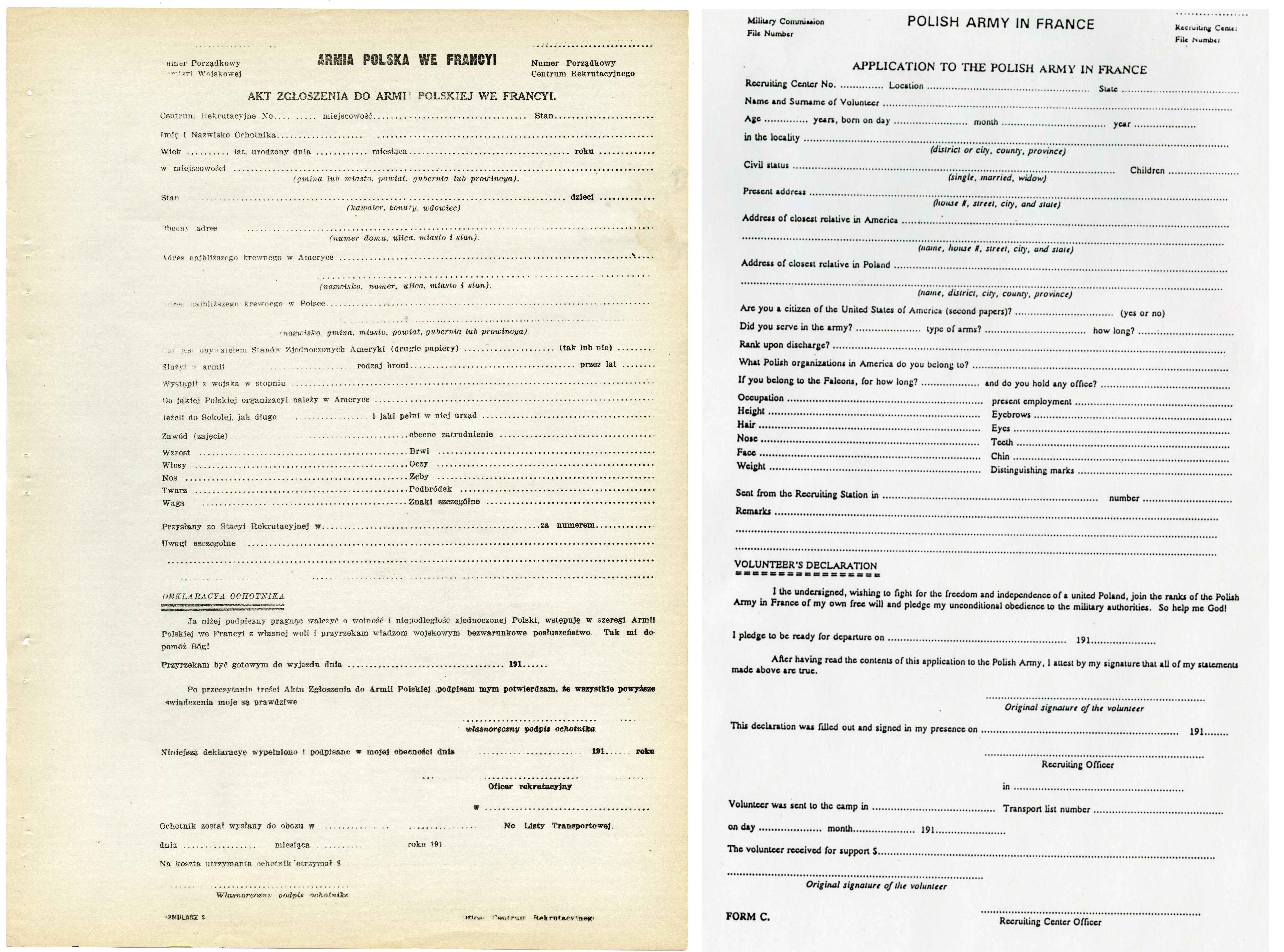
Researchers should also look into "Group L," which consists of various loose papers that can provide additional context. Indices for these records are maintained by the Polish Genealogical Society of America (PGSA) and the Foundation for East European Family History Studies (FEEFHS).
More Than a Uniform
The image of those sealed trains moving through the dark of Europe remains a powerful symbol of the diaspora’s commitment. The records found in Forms A, B, and C carry the names, origins, and personal details of a generation willing to "attack from across the sea" for a country many had only known through their parents' stories.
The role of the diaspora in 1918 was profoundly personal. If you are looking to bridge the gap between your family’s life in America or Canada and their ancestral home, our team at GenealogyDirect can help. We connect you with local researchers in Poland and France who can navigate these military files to help you find the specific story of your Hallerczyk.
Useful links
- Haller's Army index to search the index
- The Polish Museum of America