The Letters That Never Arrived
In 1941, a historian discovered forgotten boxes of intercepted emigrant letters. Confiscated by tsarist censors, they reveal dangerous journeys, divided families, and survival advice. Discover how combining these silenced voices with ship manifests transforms names on a list into deeply human stories.
Written by Arnaud Ruiz
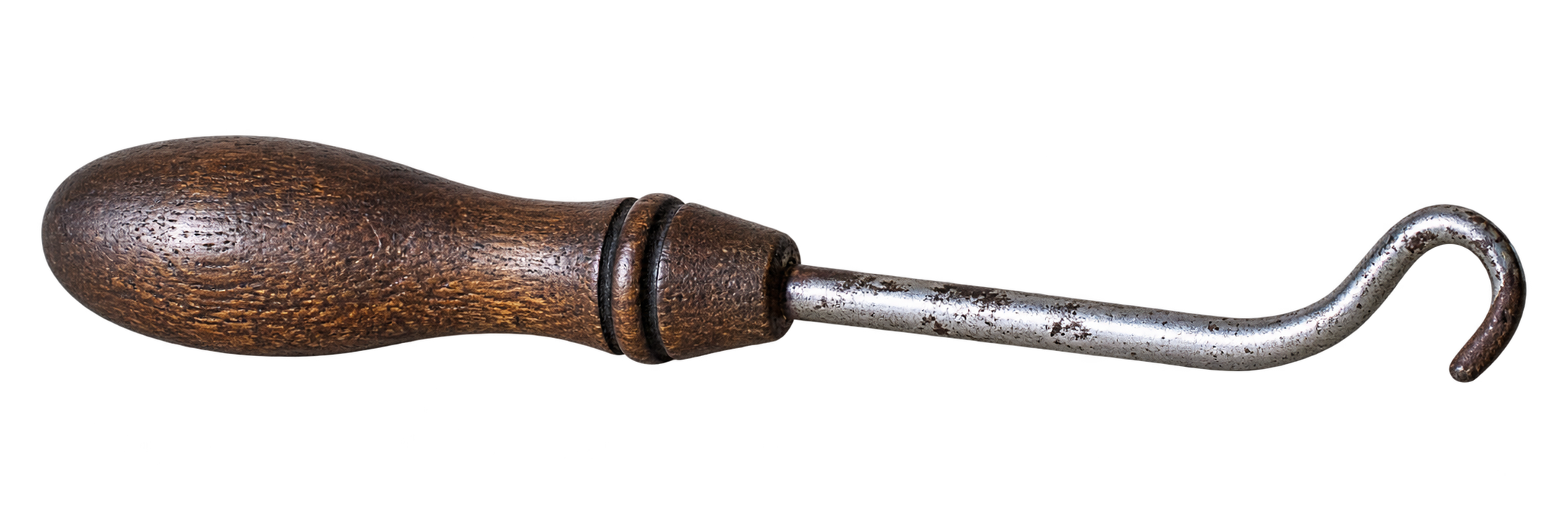
For the 19th-century immigrant, the grueling transatlantic journey ended with one final hurdle: the cold touch of a small, silver-plated instrument known as the buttonhook. In a Victorian household, it was a mundane tool, its curved neck designed to fasten the tiny, stubborn buttons on shoes and dresses. At Ellis Island, however, it took on a sinister role in the hands of medical inspectors.
Inspectors used the metal hook to pull back the eyelids of arriving passengers, searching for the telltale grainy inflammation of trachoma. To the immigrant, the sensation was one of sharp, clinical violation; to the inspector, it was the gatekeeping of a nation. This contagious eye disease was grounds for immediate deportation. For families who had spent their life savings to reach Manhattan, the buttonhook represented the terrifying possibility of being “rejected” or seeing loved ones “tragically split up” at the very threshold of the New World. This gritty reality stood in sharp contrast to the promise of America, serving as the final trial for those arriving from the partitioned regions of Poland and Austria in 1890–1891.
The Interrupted Silence of the "Basement Boxes"
As genealogists, we understand that our work often involves reconnecting conversations forcibly silenced by history. One of the most haunting examples of this “interrupted silence” was discovered in 1941 by Professor Witold Kula. While researching in the Polish Historical Archive during the German occupation, Kula discovered the skrzynia (boxes): a massive collection of letters sent by immigrants in America to their families in Russian-ruled Poland.
These letters never reached their destination. They were confiscated by the tsarist censor, whose red pencil became a weapon used to suppress the “ship tickets” (szyfkarty) being sent home. The Russian government viewed the high rate of emigration as a drain on manpower and used censorship to break the chain of family communication. As Professor Kula noted, the boxes contained “hundreds of individual tragedies”: marriages broken by silence, brothers whose trust was seemingly betrayed, and parents who died without a final goodbye. For over a century, these “basement boxes” held the unfulfilled longings and anxieties of families separated by an ocean and a bureaucratic decree.
Skeleton of the Search: The 1890-1891 New York Manifests
While the confiscated letters reveal the “soul” of the immigrant experience, ship manifests provide its “skeleton.” Every researcher must learn to reconcile these two worlds. A primary resource for this era is the Index of 1890–1891 New York Immigrants from Austria, Poland, and Galicia, a database of 96,699 records compiled by Dr. Howard M. Relles from the National Archives (NARA) M237 records.
Before an immigrant ever reached the medical inspectors, the ship’s captain was required to sign a Captain’s Oath. This was a legal declaration that the manifest was a “full and perfect list” designating the age, sex, calling (occupation), ability to read or write, and native country of every soul on board.
Researchers should focus on the following fields within the Relles index:
- Surname and Given Name: The passenger's name as recorded at embarkation.
- Soundex Code: The National Archives' phonetic indexing system.
- Ship’s Name and Arrival Date: Essential for identifying the specific voyage.
- Line Number: Crucial for locating the passenger on the original microfilmed manifest.
- Notes (Abbreviations):
- w: Traveled with relatives (usually grouped).
- p: Citizen of Poland.
- g: Citizen of Galicia.
- d: Deleted (the individual likely did not sail).
- m: Miscellaneous additional list (often used when manifests were split by passenger class).
The historical context of these responses is vital for the specialist. Although Poland had not officially existed for 95 years by 1891, 39% of arrivals still claimed "Poland" as their country of citizenship. A "Poland" response could imply three different partitioned regions: Austrian (Galicia), Russian (Eastern), or Prussian (Western). Furthermore, an "Austria" designation frequently meant the immigrant was from the Galician region of Austrian Poland.
Voices from the Steerage: Advice and Warnings
The "Letters from America" allow us to reconstruct the steerage experience with granular detail, offering "survival tips" that reflect the harshness of the journey.
The Price of Passage
Johann Bonkowski, writing to his parents in 1891, detailed the logistical nightmare of the trip. He noted his sister Marianna would need at least "80 rubles" for the total journey and specifically "25 marks" for the train and food once in transit. He warned her that in Torun, she must "sit only in the back" of the train for safety and should travel specifically via Bremen to secure her steamship ticket.
The "Robbers" of Hamburg
Transit ports were notorious for exploitation. Abraham Tangruza warned his wife, Toba, that the travel agencies in Hamburg were "robbers and thieves." His survival advice was strictly administrative: "ask for a receipt" for every payment made and hold the agency's address tightly.
Shipboard Survival
The steerage food was often described as "foul" or "sweet," lacking the kfas (acid or fermentation) essential to the Polish palate. S. Kazmirkiewicz urged relatives to pack "two cooked geese," "smoked sausage with garlic," and "hard cheeses" to avoid starving on the ship's rations. He also recommended "two quarts of good vodka" to serve as medicine for the lack of appetite caused by the ocean's sway.
The Choice of Berth
Tactical positioning on the ship was a matter of health. Kazmirkiewicz advised relatives to "pick out for yourselves the very first beds near the steps." He warned against the highest bunks, where "smells linger," and recommended the lower berths because the ship "rocks the most" at its ends.
The Twenty-Year Search for Franciszka Jagielska
The power of genealogical persistence is personified in the research of journalist Małgorzata Szejnert. Using the "Kula letters" as a map, she attempted to track eight individuals who never received their intercepted correspondence.
She successfully located Franciszka Jagielska. In 1912, two full decades after her husband had sent a despair-filled letter from Pittsburgh that was confiscated by tsarist censors, Franciszka finally arrived at Ellis Island aboard the steamer Königen Luise. She was 42 years old, illiterate, and penniless, a small woman carrying only the hope of finding a husband she had not seen in twenty years. Her arrival, following a silence imposed for two decades by a censor’s box, illustrates why we search: the skeleton of a manifest line can eventually lead us to the soul of a completed conversation.
The Genealogist’s Practical Toolkit
For those seeking to finish the "interrupted conversations" of their own ancestors, these resources are the starting point:
Where to Find the Records
| Resource | Location / Access |
|---|---|
| NARA Microfilm M237 | NARA branches in Washington DC, NYC, Waltham (MA), Denver, and Chicago; or via local LDS Family History Centers. |
| 1890-1891 New York Index | JewishGen Database / Dr. Howard Relles’ Index. |
| Public Libraries | NYPL, Boston Public Library, Houston Public Library, and the Allen County Public Library. |
| Confiscated Letters | State Archives in Warsaw |

Research Tip: Ship manifests were often split by passenger class. If you locate an ancestor in an index but they do not appear on the expected manifest page, search for "another numbered list" (indicated by the 'm' abbreviation). Some captains maintained separate pages for steerage and cabin passengers.
Beyond the Names on a Manifest
The history of 19th-century Polish immigration lives in the tension between the promise of Ellis Island and the ordeal of its inspection rooms, between humanitarian ideals and the cold bureaucracy of the buttonhook and the censor. Some of the most valuable records are those created for purposes far removed from family history: captains’ oaths, medical notations, and intercepted pleas from husbands and wives waiting decades to be reunited.
If you believe your family’s history may be hidden within these archives, GenealogyDirect can connect you with researchers familiar with NARA collections or repositories such as the State Archives in Warsaw . By posting a request, you can seek help locating specific records and recovering the voices that have been missing from your family’s story for generations.